Zoning Literacy Assistant
Regulatory literacy · retrieval, synthesis & independent verification · Claude
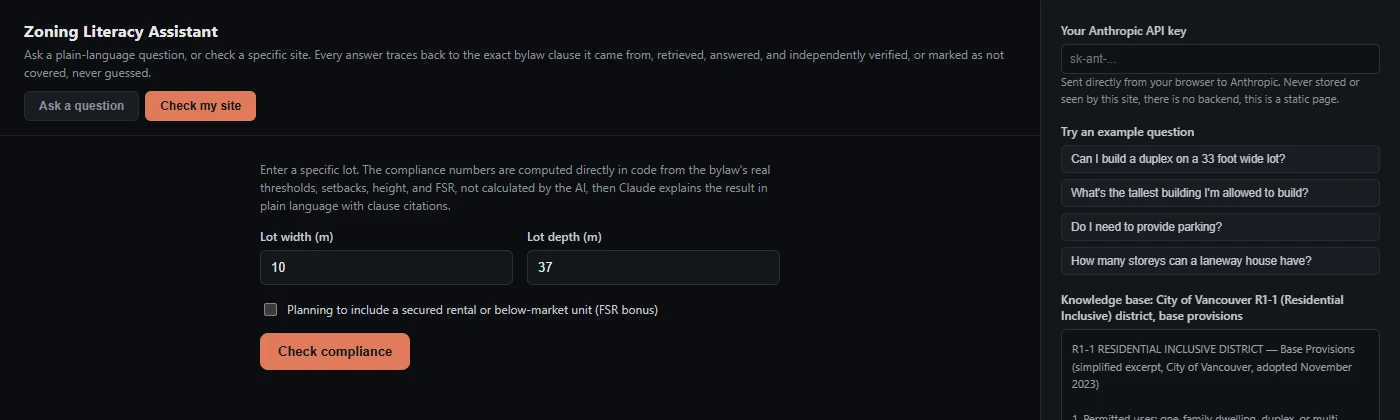
The Zoning Literacy Assistant investigates how AI can support public understanding of land use regulation while making the evidence and limits of each response explicit. Source retrieval, citation, verification, and uncertainty reporting are central design requirements. The objective is to help readers assess regulatory explanations against the supplied bylaw text.
System Capabilities
The assistant accepts questions in plain language, such as whether a duplex is permitted on a lot. Responses cite the exact supporting clause, and the system indicates when the supplied text does not address a question. A separate site assessment uses lot dimensions and rental conditions to report the applicable unit tier, buildable footprint after setbacks, and estimated floor area, with a citation for each result.
System Architecture
The Claude-based workflow comprises three stages. Retrieval selects potentially relevant clauses using their titles. Synthesis constructs an answer from the selected full text. Independent verification checks the response and identifies potentially omitted clauses. Site calculations are performed deterministically in code; the language model communicates these results while preserving a record of sources, calculations, and unresolved uncertainty.
Evaluation
The prototype includes example questions for testing with an Anthropic key. Answerable and unsupported cases support examination of both cited responses and the system's handling of insufficient evidence. The site assessment also illustrates changes to conditional floor space rules when rental provisions apply.